


The Kubermatic team is proud to announce the release of Kubermatic Developer Platform (KDP) versions 1.0.0 and 1.1.0. KDP has been GA since January this year, and these releases mark the official arrival of our fully production-ready, enterprise-grade platform.
KDP is our internal developer platform: an API backbone where platform teams publish services and developers consume them instantly, no ticket required.
KDP runs on kcp, giving every team its own isolated, Kubernetes-native workspace on a shared control-plane infrastructure. Each workspace behaves like a full Kubernetes API server, so kubectl, CI/CD, and GitOps all work unchanged.
Release Highlights of KDP 1.0.0 and 1.1.0
Say hello to Blueprints:
- Powered by kro, blueprints allow platform engineers to define reusable, multi-resource and service compositions. Developers can easily discover and consume these via the Service Catalog, without needing to understand underlying infrastructure complexities.
- Skills are now included for AI-assisted blueprint generation, making it easier to build even the most sophisticated scenarios.
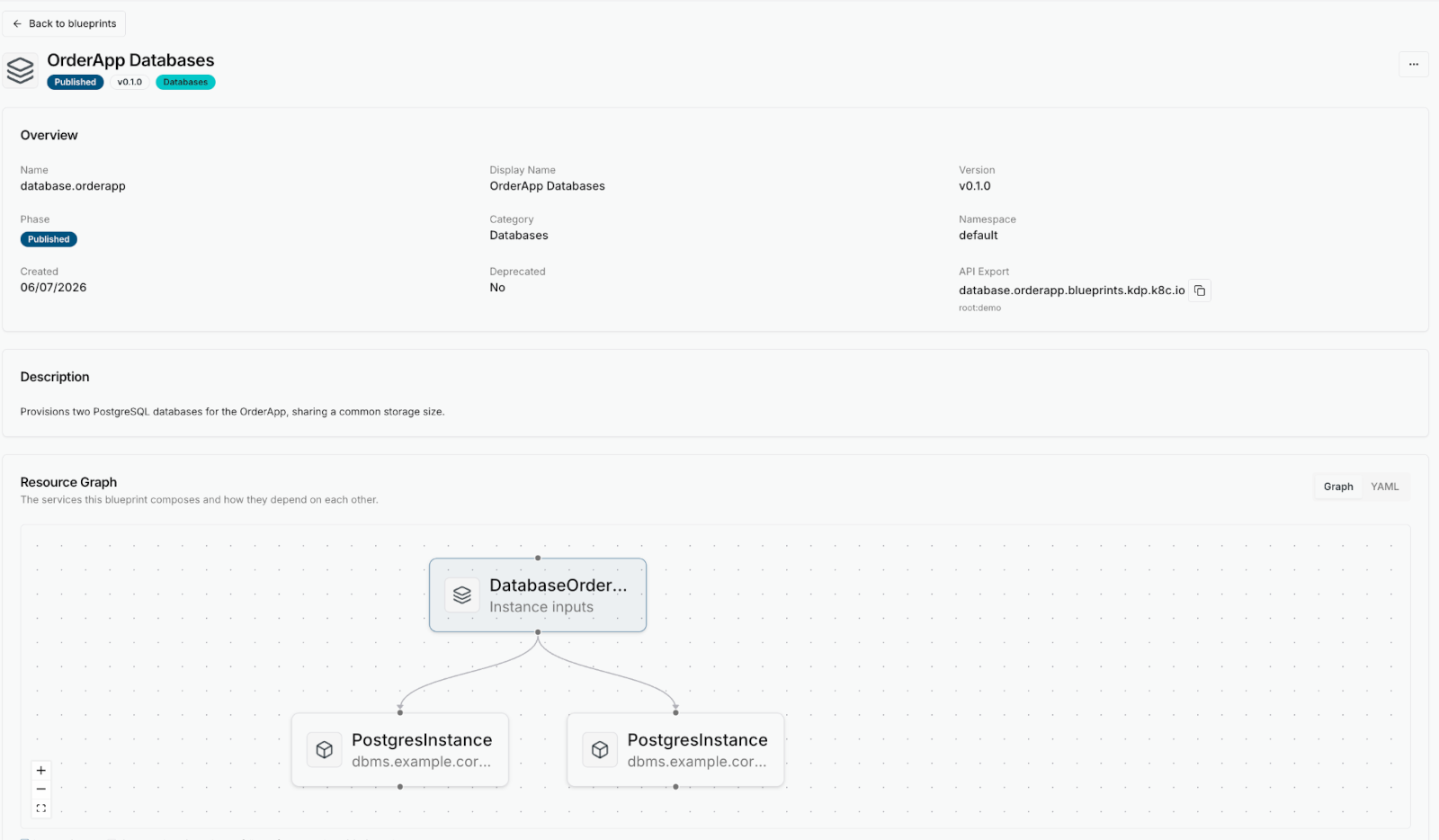
The refreshed KDP dashboard natively visualizes complex service architectures, allowing teams to view resource dependencies at a glance.
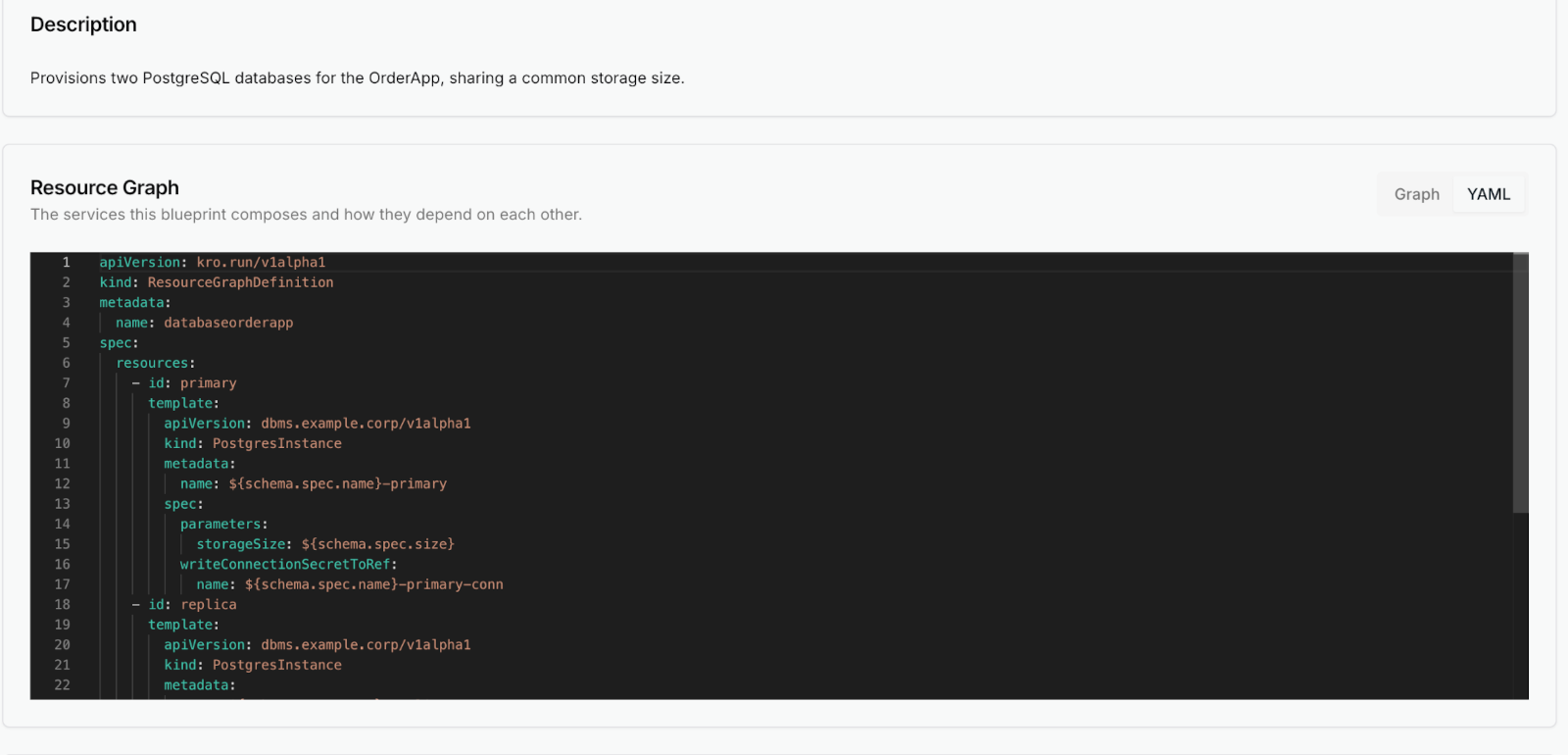
The same view also exposes the underlying declarative YAML via kro, making it easy for platform teams to manage service compositions as code.
New documentation on integrations:
- With kbind, you can order services directly from your Kubermatic cluster. You do not need to leave your app’s Kubernetes cluster.
- With External Secrets Operator, you can ship connection details for ordered services for simpler scenarios.
Various fixes:
- A smoother, more responsive dashboard experience with a refreshed service catalog and Blueprint views.
- Faster page loads and improved responsiveness across the UI.
- Greater stability and reliability, with numerous bug fixes under the hood.
Updates:
- kcp kcp bumped to v0.32.3, running on Kubernetes 1.36.0.
Why It Matters
KDP eliminates the primary bottleneck in modern software delivery: the operational friction between writing application code and provisioning the infrastructure required to run it. Here is how that translates to daily operations:
- Eliminate Ticket-Driven Operations: Developers no longer need to open Jira tickets or wait on manual Slack approvals for a database or cache. They request resources directly via the API and receive them instantly.
- Zero Tooling Friction: There are no proprietary UIs or custom command-line wrappers for developers to learn. KDP integrates natively with standard Kubernetes, meaning existing kubectl workflows, CI/CD pipelines, and GitOps processes work unchanged out of the box.
- Scalable Platform Engineering: Platform teams can use Blueprints to package complex, multi-resource architectures into standardized templates. This declarative approach allows a lean operations team to support hundreds of developers.
- Cost-Effective Multitenancy: Every development team gets a dedicated, isolated workspace that behaves like its own cluster, without the cost or overhead of running separate physical clusters.
What’s Inside Kubermatic Developer Platform
KDP is an all-in-one control plane designed to eliminate friction from the development lifecycle. Built on open-source technology, its core foundational components include:
- kcp: The architectural backbone that provides every team with an isolated, Kubernetes-native workspace on a shared control-plane infrastructure.
- kro: The engine powering custom resource orchestration and multi-resource service compositions.
- kbind: The tool that enables secure, cross-cluster service ordering directly from a developer’s workspace.
- Service Catalog: An intuitive dashboard designed for discovering, provisioning, and managing services end-to-end.
Get Started with KDP today!
Whether you’re building your internal developer platform from scratch or replacing a ticket-driven provisioning process, KDP gives you real Kubernetes APIs your developers can build on directly.
KDP requires a Kubernetes cluster (minimum 3 nodes) with a CSI driver, cert-manager, and an Ingress controller (NGINX or Gateway API). Please contact Kubermatic for access and pricing.


